
Super Bowl LX sees Bad Bunny celebrate Latin American identity on world stage as fans say, ‘That is what it means to be proud of where you come from’
Simran Guleria | Feb 09, 2026, 08:35 IST
Bad Bunny’s Super Bowl LX halftime show celebrates Latin American identity with flags and unity messages, drawing mixed reactions and praise for cultural pride.

Bad Bunny turned the Super Bowl halftime show into something far more layered than a burst of music and celebrity cameos. Performing at Super Bowl LX in Santa Clara, California, the Puerto Rican star used the global stage to highlight unity, cultural pride, and identity, sparking conversation long after the lights dimmed.
Rather than leaning into overt political statements, Bad Bunny chose symbolism. His performance unfolded as a celebration of diversity, presenting America as a collective of cultures rather than a single story. For many viewers, the message landed quietly but powerfully.
![X| Bad Bunny on stage during the Super Bowl LX halftime show.]()
As the set approached its final moments, the visuals took centre stage. After performing CAFé CON RON, dancers entered the field carrying flags from countries across North and South America. Speaking in English, Bad Bunny said, “God bless America,” before naming every nation from both continents. Behind him, the words “The only thing more powerful than hate is love” lit up the stage.
The singer did not reference Immigration and Customs Enforcement during the show, despite having criticised the agency publicly in recent days. That absence stood out, but it appeared intentional. Rather than direct protest, Bad Bunny opted for a softer yet widely accessible form of expression.
![X| The Puerto Rican singer highlights Latin American pride with flags.]()
He reinforced the theme by holding up a football emblazoned with the words “Together, we are America,” a visual that felt particularly pointed in a setting synonymous with traditional displays of patriotism. The show closed with his hit DtMF, bringing a celebratory end to a performance rooted in meaning.
Rather than leaning into overt political statements, Bad Bunny chose symbolism. His performance unfolded as a celebration of diversity, presenting America as a collective of cultures rather than a single story. For many viewers, the message landed quietly but powerfully.
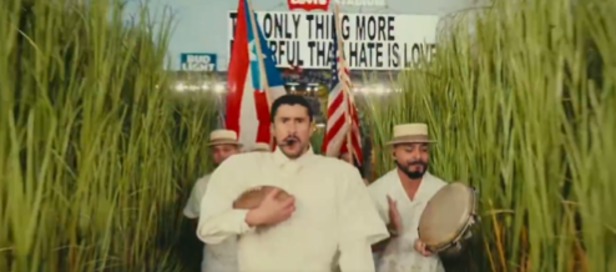
Image credit : X| Bad Bunny on stage during the Super Bowl LX halftime show.
As the set approached its final moments, the visuals took centre stage. After performing CAFé CON RON, dancers entered the field carrying flags from countries across North and South America. Speaking in English, Bad Bunny said, “God bless America,” before naming every nation from both continents. Behind him, the words “The only thing more powerful than hate is love” lit up the stage.
A statement built on symbolism, not slogans
The singer did not reference Immigration and Customs Enforcement during the show, despite having criticised the agency publicly in recent days. That absence stood out, but it appeared intentional. Rather than direct protest, Bad Bunny opted for a softer yet widely accessible form of expression.

Image credit : X| The Puerto Rican singer highlights Latin American pride with flags.
He reinforced the theme by holding up a football emblazoned with the words “Together, we are America,” a visual that felt particularly pointed in a setting synonymous with traditional displays of patriotism. The show closed with his hit DtMF, bringing a celebratory end to a performance rooted in meaning.
OH BAD BUNNY ATE THIS SO FCKING BAD LIKE THIS IS JUST BEAUTIFUL😭🥹pic.twitter.com/1QcJyJqlnK
— 𝗱𝗮𝗻𝗻𝘆🫧💚 (@beyoncegarden) February 9, 2026
Guest appearances from Cardi B, Ricky Martin, and Lady Gaga added star power, but the emotional weight of the set rested firmly on Bad Bunny’s message rather than its cameos.
Mixed reactions to Bad Bunny’s Super Bowl moment
One X user wrote, “That’s what it means to be proud of where you come from. Bad Bunny is proud of his roots,” applauding the visible celebration of heritage.
Another focused on the staging rather than the lyrics, commenting, “Don’t understand a word but the setup is fire.”
Criticism, however, was just as loud. One user remarked, “If you take politics out of this, the performance was just ok, not one that will be remembered by anyone.”
If you take politics out of this, the performance was just ok, not one that will be remembered by anyone…,
— BM - ster (@bm_ster) February 9, 2026
Another went further, calling the set “horrible” and labelling Bad Bunny an “inferior genre artist living down to expectations.”
Some viewers even questioned his vocal ability, with one post asking, “Is he singing or just saying words? Is he even a singer?”
Why the moment matters beyond the stage
Bad Bunny’s Super Bowl appearance followed a week of heightened public debate around immigration in the US. Just days earlier, at the Grammy Awards, he used his Album of the Year speech to criticise ICE directly, dedicating his win to people forced to leave their homelands in pursuit of opportunity.
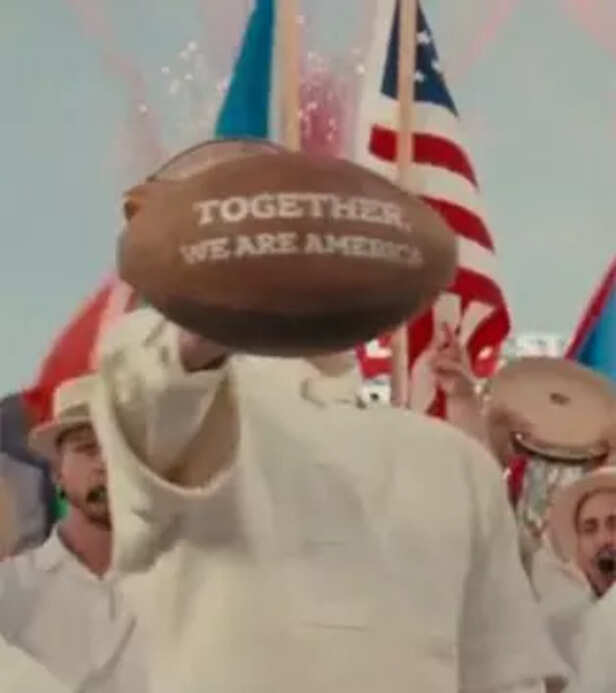
Image credit : X| Crowd cheers as Bad Bunny delivers a message of pride and unity.
Those comments came amid nationwide protests and growing pressure on political leaders and corporations to address immigration enforcement and related violence. Against that backdrop, his Super Bowl performance felt deliberate, restrained, and carefully calibrated for a global audience.
By choosing unity over outrage and symbolism over slogans, Bad Bunny delivered a message that was both accessible and powerful. It was not a protest shouted from the stage, but a reminder quietly woven into one of America’s most watched cultural moments. In doing so, he proved that sometimes the strongest statements are the ones that invite reflection rather than demand agreement.
Bad Bunny celebrates Latin American pride at Super Bowl LX
By Simran Guleria

Kim Kardashian and Lewis Hamilton go public at Super Bowl
By Simran Guleria

Diplo says BTS are about to break pop music again
By Shivani Negi

Mack Hollins stuns fans with barefoot Super Bowl arrival
By Simran Guleria

Viral clip of Bad Bunny sitting through ‘God Bless America’ fuels Super Bowl outrage
By Shivani Negi

Super Bowl LX row deepens after Logan Paul’s Bad Bunny jab
By Simran Guleria

The internet can’t unsee Tom Brady dancing with Alix Earle
By Shivani Negi
